Today's
EarthStation1.com 15% (Or More!) Off Commemorative Memorial Title:
TV Commercials: The Classics Vol. 1 DVD, Video Download, USB Drive
Today, September 4, 2026
September 4: Eat An Extra Dessert Day: --
The dictionary definition of the word dessert might mean "a
sweet food eaten at the end of a meal," but today, you get an
instant replay on that! So don't hold back - you can indulge in
dessert any time during the day and even sneak to the refrigerator
after bedtime to have that last slice of cake. We wish we knew who
the creator of this delightfully sweet holiday was so we can thank
them and give them a huge slice of cake. Unfortunately, the
origins of this day are lost in time, but we can make up for it by
enjoying the range of desserts on offer. For many, dessert is a
much-anticipated highlight and a meal without some kind of
mouthwatering finale seems incomplete. Some items are typical of
the dessert menu. Cakes, pies, cookies, and ice cream are
customarily served at the end of a meal, but if you plan on having
sweet food any time of the day, then anything sweet will do. The
term dessert stems from the French word 'desservir,' meaning 'to
clear the table.' After the main meal the table is cleared of used
dishes and dessert is then served. Sweet food items have been
around forever and it is not clear which was the first dessert,
but ice cream dates back to 3000 B.C. and is a possibility. The
evolution of the dessert was propelled by the use of fruit and
sugar. Sugar was used in India before 500 B.C., from where it made
its way to China and Macedonia over the next 1,000 years. By the
12th century, the sugar trade expanded to Europe and dessert
production rocketed after the Industrial Revolution when
preservatives and the processing of food changed for the better.
Today, recipe development has reached new heights and there is a
variety of interesting ingredients available. Visual presentation
and colorful garnishing have become popular and important factors
in raising baking and dessert making into a culinary art form. On
Sale Until Midnight Tonight PT!
https://store.earthstation1.com/tv-commercials-the-classics-vol-1-dv1.html
Today's
EarthStation1.com 15% (Or More!) Off Commemorative Memorial Title:
TV Commercials: The Cable Age Classics Vol. 4 MP4 Video Download
DVD
Today, September 4, 2026
September 4: National Spice Blend Day: --
A day to allow the alluring aroma of spices to tempt your senses!
Home cooks and professional chefs alike know herbs and spices
bring our favorite foods alive on our palates. That is why every
recipe, every food blog, and every cook stresses the importance of
quality herbs and spices for everything you cook. National Spice
Blend Day celebrates the unique combinations of flavors found in
handpicked spice blends worldwide. Does a little smoky paprika,
cumin, and rosemary tantalize your senses? Did you know there are
four main types of cinnamon, each with different flavor profiles?
Depending on where the cinnamon grows, the warmth, sweetness, and
color change. When you blend it with nutmeg, ginger, cardamom, and
other spices, it brings an extra special touch to your baking and
other recipes. Herbs are also vital to every kitchen, and just
like spices, the Earth has created a bountiful variety! Worldwide,
so many kinds of Basil grows it would be impossible to list them
all, but each one imbues unique characteristics worth exploring.
When this herb is combined with curry or Mediterranean blends, you
know you're cooking for a celebration. With only a few examples,
we know we have your creative and gastric juices flowing for
National Spice Blend Day! On Sale Until Midnight Tonight PT!
https://store.earthstation1.com/tv-commercials-the-cable-age-classics-vol-4-mp4-video-download-d44.html
Today's
EarthStation1.com 15% (Or More!) Off Commemorative Memorial Title:
Vietnam: A Country Not A War - George Page Wildlife DVD, Download,
USB
Today, September 4, 2026
September 4: National Wildlife Day: -- An
annual encouragement to improve awareness of the species around us
and in the broader world. This National Day focuses on endangered
species, preservation, and conservation efforts around the world.
Zoos, aviaries and marine sanctuaries provide a variety of ways to
get involved. No matter where you live, opportunities abound to
learn and participate in the day. Wildlife doesn't only exist in
the forest or outside the city limits. Look closely. The creatures
and animals sharing our world live under our feet and in the sky
above us. Our rivers, lakes and oceans are teeming with wildlife
of all sizes. It's essential to understand how we impact the
habitats that animals need to survive. Their homes supply their
food and shelter. Since wildlife relies on a stable habitat,
understanding conservation and preservation is important.
Developing strategies helps to maintain existing habitats and
repair or replace those that have been destroyed. These strategies
are especially important when a decline in a species is detected.
For example, each year in August, International Whale Shark Day
brings attention to the plight of the world's largest fish.
Despite efforts, the gentle giant continues to decline in numbers.
Around the world, facilities and organizations will present
seminars and educational programs. Additionally, podcasts and
documentaries alert us to the changing conditions for various
species around the world. Some may be as close as your own
backyard. From the sky to the depths of the ocean, wildlife
surrounds us. To observe National Wildlife Day: Participate in a
presentation. Volunteer to fund-raise for rehabilitation services.
Other ways to celebrate the day include learning about the needs
of endangered species and how conservation efforts work; While
learning, implement your own techniques, as suggested by
preservationists; Go on a wildlife walk and learn about the
inhabitants near you. Visit the National Wildlife Federation to
learn more. On Sale Until Midnight Tonight PT!
https://store.earthstation1.com/vietnam-a-country-not-a-war-dvd-wildlife-of-vietnam.html
Today's
EarthStation1.com 15% (Or More!) Off Commemorative Memorial Title:
Newspaper Publishing History Documentaries DVD, Download, USB
Drive
Today, September 4, 2026
September 4: National Newspaper Carrier
Day: -- An annual day to recognize the dedicated newspaper
carriers who deliver the news in the wee hours of the morning! A
lot has changed since the first newspaper carrier. Not only have
the routines changed, but their methods and the age of the people
delivering has changed, too. However, the newspaper carrier still
exists in some form. Each and every newspaper carrier owe their
start to an enterprising young immigrant in New York City over 180
years ago. As the tradition gradually fades, their history becomes
no less fascinating. According to a captioned photo released by
the Museum of the City of New York, The Sun's publisher Benjamin
Day hired the first paperboy on Septemeber 4, 1833. A 10-year-old
Barney Flaherty answered the advertisement that September day. And
although the ad specified for "steady men" to apply,
Flaherty so impressed the editor that Day was so impressed by the
boy's sincerity; he gave him the job. Down on the corner,
passersby soon heard Flaherty hawking his sales pitch. Eventually,
the universal chorus of boys (and sometimes girls) calling,
"Paper! Get your paper, here!" could be heard on the
streets selling papers. "A number of steady men can find
employment by vending this paper. A liberal discount is allowed to
those who buy to sell again." - Benjamin Day's 1833
advertisement in The Sun. In 1960, The Newspaper Carrier Hall of
Fame was created. It acknowledges some famous newspaper carriers
in our nation's history, too. Included in the Newspaper Carrier
Hall of Fame are Martin Luther King Jr., Warren Buffet, and John
Wayne. On Sale Until Midnight Tonight PT!
https://store.earthstation1.com/newspaper-publishing-history-dvd.html
Today's
EarthStation1.com 15% (Or More!) Off Commemorative Memorial Title:
And Away We Go! US Cars + Bonus Internal Combusion Engine MP4 DVD
Today, September 4, 2026
September 4: E Day:-- September 4, 1957:
The Industrial Revolution: The Third Industrial Revolution
(1947-Present): The Automotive Industry: The History Of The
Automobile: The History Of The Automotive Industry: Product
Rollouts: Automobile Rollouts: E Day (The Rollout Of The Ford
Edsel): -- The Ford Motor Company introduces the Edsel automobile
amid considerable publicity on "E Day". They were also
promoted by a top-rated television special, The Edsel Show, on
October 13, 1957, but the promotional effort was not enough to
counter the adverse initial public reaction to Edsel styling and
unconventional build. After the launch date, Edsel was described
as a "reborn LaSalle," a General Motors brand that had
disappeared in 1940. For months, Ford had been telling the
industry press that it "knew" (through its market
research) that there would be great demand for the vehicles. Ford
also insisted that, in the Edsels, it had built exactly the
"entirely new kind of car" that Ford had been leading
the buying public to expect through its preintroduction publicity
campaign for the cars. In reality, however, Edsels shared their
engineering and bodywork with other Ford models, and the
similarities were apparent once the vehicles were viewed
firsthand. Edsel is an automobile brand that was planned,
developed, and manufactured by the Ford Motor Company for model
years 1958 to 1960. With the Edsel brand, Ford had expected to
make significant inroads into the market share of both General
Motors (GM) and Chrysler and close the gap between itself and GM
in the domestic American automotive market. Ford invested heavily
in a yearlong teaser campaign leading consumers to believe that
Edsels were the cars of the future - an expectation they failed to
meet. After being unveiled to the public, they were considered to
be unattractive, overpriced, and overhyped. Edsels never gained
popularity with contemporary American car buyers and sold poorly.
The Ford Motor Company lost 250M USD on Edsel development,
manufacturing, and marketing. The very name "Edsel"
became a popular symbol for a commercial failure. Despite this,
the project would see longer-term benefits for the company, as
Ford invested over 100M USD to build compact cars over the 1960s,
such as the successful 1960 Ford Comet, essentially an Edsel with
a Ford Falcon body. While the Edsel trademark vertical grille saw
a nearly universal negative response by contemporary buyers and
critics, multiple subsequent automobile manufacturers have
employed narrow vertically-oriented grilles with greater success
in the marketplace, including Pontiac, Jaguar, Subaru, Lancia,
Alfa Romeo, and Saab. Through technological advances, multiple
features introduced by Edsel cars, including self-adjusting
brakes, automatic climate control, steering wheel-mounted
transmission controls, and childproof rear door locks are no
longer impractical ideas, but included in many current production
features as options or standard equipment. More than half a
century after its spectacular failure, Edsels have become highly
collectible items among vintage car hobbyists. Fewer than 10,000
Edsels survive and they are considered valuable collector's items.
A mint-condition Edsel convertible from any of its three model
years may sell for over 100M USD as of 2023. The rarest Edsel by
body style is the 1960 Ranger convertible: only 76 were built; 25
survive as of 2023. The rarest Edsel by model is the 1960 Ranger
deluxe interior 4-door hardtop, model 57B. Originally intended to
be released as the 1960 Corsair, only 31 units were produced. On
Sale Until Midnight Tonight PT!
https://store.earthstation1.com/and-away-we-go-american-automobile-history-dvd.html
Today's
EarthStation1.com 15% (Or More!) Off Commemorative Memorial Title:
The Story Of Civilization: Will & Ariel Durant DVD, MP3
Download, USB
Today, September 4, 2026
September 4, 476: The Fall Of The Western
Roman Empire (The Fall Of The Roman Empire, The Fall Of Rome): --
Romulus Augustulus, last emperor and alleged usurper of the
Western Roman Empire, is deposed by Odoacer, who proclaims himself
"King of Italy", and thereby bringing an end to the
Roman Empire in the West. Flavius Romulus Augustus (c. AD
460-after AD 476; possibly still alive as late as AD 507), known
derisively and historiographically as Romulus Augustulus
(Augustulus "Little Augustus"; the name Romulus was also
changed derisively to Momyllus meaning "little disgrace"),
was the Roman emperor who ruled the Western Roman Empire from 31
October AD 475 until 4 September AD 476. He is often described as
the "last Western Roman emperor", though some historians
consider this to be Julius Nepos. His deposition by Odoacer
traditionally marks the end of the Roman Empire in the West, the
fall of Ancient Rome, and the beginning of the Dark Ages and
Middle Ages in Western Europe. The historical record contains few
details of Romulus' life. He was the son of Orestes, a Roman who
once served as a secretary in the court of Attila the Hun before
coming into the service of Julius Nepos in AD 475. In the same
year he was promoted to the rank of magister militum, but then led
a military revolt that forced Nepos to flee into exile. With the
capital of Ravenna under his control, Orestes appointed his son,
Romulus to the throne despite the lack of support from the eastern
court in Constantinople. Romulus, however, was little more than a
child and figurehead for his father's rule. After ten months in
power, during which time his authority and legitimacy were
disputed beyond Italy, Romulus was forced to abdicate by Odoacer,
a Germanic foederatus officer who defeated and executed Orestes.
After seizing control of Ravenna, Odoacer sent the former emperor
to live in the Castellum Lucullanum in Campania, after which he
disappears from the historical record. Odoacer would himself be
overthrown by Theoderic The Great, King of the Ostrogoths, at the
The Battle Of Isonzo (489) during the Roman-Germanic Wars.
Theoderic killed Odoacer with his own hands in 493 while they
shared a meal. On Sale Until Midnight Tonight PT!
https://store.earthstation1.com/story-of-civilization-will-amp-ariel-durant-mp3-dvd-11-audiobo311.html
Today's
EarthStation1.com 15% (Or More!) Off Commemorative Memorial Title:
The French Revolution Series + Irish Rebellion & You Are There
MP4 DVD
Today, September 4, 2026
September 4, 1797: The Age Of
Enlightenment (The Enlightenment, The Age Of Reason): The Age Of
Revolution: The Atlantic Revolutions: The French Revolution: The
Coup Of 18 Fructidor: -- Members of the French Directory seize of
power as their opponents, the Royalists, were gaining in strength.
The Coup Of 18 Fructidor, Year V, was a turn toward dictatorship
and the failure of liberal democracy of the Directory, who was
responsible for chronic violence, injustice, and repression. The
Directory was a five-member committee which governed France from
1795, when it replaced the Committee of Public Safety. It was
overthrown by Napoleon Bonaparte in the Coup of 18 Brumaire Year
VII (November 8-9, 1799) and replaced by the French Consulate. It
gave its name to the final four years of the French Revolution. On
Sale Until Midnight Tonight PT!
https://store.earthstation1.com/the-french-revolution-dvd-3-part-tv-documentary-serie3.html
Today's
EarthStation1.com 15% (Or More!) Off Commemorative Memorial Title:
KTLA: The First 35 Years: Los Angeles TV Station Channel 5: MP4 Or
DVD
Today, September 4, 2026
September 4, 1781:The Spanish
Colonization Of The Americas: The Spanish Colonization Of New
Spain: Spanish Colonial Pueblos And Villas In North America:
Spanish Colonial Pueblos And Villas In New Spain: El Pueblo De
Nuestra Senora La Reina De Los Angeles Del Rio De Porciuncula
(Spanish "The Town Of Our Lady, The Queen Of The Angels Of
The Porciuncula River") (Shortened to Pueblo De Los Angeles
(Spanish, "Town Of The Angels): City Foundings: The Founding
Of Pueblo De Los Angeles (The Founding Of The Town Of Angels): --
Los Angeles is founded by the Spanish Governor of California,
Felipe de Neve, near the site of the Native American village of
Yang-na. It was founded as El Pueblo de Nuestra Senora La Reina de
los Angeles de Porciuncula (The Village of Our Lady, the Queen of
the Angels of Porziuncola) by the 44 Los Angeles Pobladores
(Spanish: Los Pobladores Del Pueblo De Los Angeles [English: The
Townspeople Of Los Angeles]). As local lore tells it, the 44
pobladores gathered at San Gabriel Mission and, escorted by a
military detachment and two priests from the Mission, set out for
the site that had been chosen by Juan Crespi, OFM (Catalan: Joan
Crespi), a Franciscan missionary and explorer of Las Californias.
In reality, several of the families were probably already working
on their plots of land as early as late July that year. Governor
de Neve gave the new town its name. In accordance with the Laws of
the Indies -- the body of laws issued by the Spanish Crown in 1573
for the American and the Asian possessions of its empire -- and
the Governor's Reglamento Para El Gobierno De La Provincia De
Californias (Regulation For The Government Of The Province Of The
Californias), the new towns in Alta California (Spanish: High
California) were to have four square Spanish leagues (equivalent
to 3 millas (Spanish miles, equiv. to 1.3932 km / 0.62137119 mi)
of land; that is a distance marked by one league in each cardinal
direction from the town center. The streets, however, were laid
out at forty-five degrees from the cardinal directions, a plan
which is still preserved in Downtown Los Angeles. The old town
limits are still marked by Hoover and Indiana Streets in the west
and east respectively. In 1784 an asistencia or sub-mission of the
San Gabriel Mission was established on the central plaza, to
provide religious services to the settlers. On Sale Until Midnight
Tonight PT!
https://store.earthstation1.com/ktla-the-first-35-years-tv-channel-5-la-355.html
Today's
EarthStation1.com 15% (Or More!) Off Commemorative Memorial Title:
Edison's Miracle Of Light History Peter Coyote MP4 Video Download
DVD
Today, September 4, 2026
September 4, 1882: Electricity: The History Of Electricity: The First Industrial Revolution/The Second Industrial Revolution (1760-1914): The Electrical Age: The History Of Electrical Engineering: Electric Power: The History Of Electric Power: Electric Power Transmission: The History Of Electric Power Transmission: Direct Current: The Pearl Street Station: -- The electrical age begins as Thomas Edison flips the switch to the first commercial electrical power plant in history, the Pearl Street Station just south of Fulton Street, lighting one square mile of lower Manhattan. Pearl Street Station was also the world's first cogeneration plant. While the steam engines provided grid electricity, Edison made use of the thermal byproduct by distributing steam to local manufacturers, and warming nearby buildings on the same Manhattan block. The Pearl Street Station cogeneration plant was located at 255-257 Pearl Street in Manhattan on a site measuring 50 by 100 feet (15 by 30 m) and fired by coal. It began with six dynamos, and it started generating electricity on September 4, 1882, serving an initial load of 400 lamps at 82 customers. By 1884, Pearl Street Station was serving 508 customers with 10,164 lamps. The station was built by the Edison Illuminating Company, which was headed by Thomas Edison. The station was originally powered by custom-made Porter-Allen high-speed steam engines designed to provide 175 horsepower at 700 rpm, but these proved to be unreliable with their sensitive governors. They were removed and replaced with new engines from Armington and Sims that proved to be much more suitable for Edison's dynamos. The station ran until it burned down in 1890, destroying all but one dynamo, which is now kept in the Greenfield Village Museum in Dearborn, Michigan. The station used reciprocating steam engines to turn direct-current generators. Because of the DC distribution, the service area was small, limited by voltage drop in the feeders. The War of Currents between use of alternating current and direct current eventually resolved in favor of AC distribution and utilization, although some DC systems persisted to the end of the 20th century. On Sale Until Midnight Tonight PT! https://store.earthstation1.com/edmioflihipe.html
Today's
EarthStation1.com 15% (Or More!) Off Commemorative Memorial Title:
150 Years Of Photography Hal Holbrook + Bonus Title DVD Video
Download
Today, September 4, 2026
September 4, 1888: Great Inventions:
Photography: The History Of Photography: The Amateur Photography
Age: Cameras: The Kodak Camera (The Kodak Black Camera): -- The
age of amateur photography begins as the first popular camera, the
Kodak camera, is patented by George Eastman as he registers the
trademark Kodak, a name he invented, a camera that uses first
practicable roll film, the one Eastman patented in 1884. Before
then, both apparatus and processes were too burdensome to classify
photography as recreation. The "Kodak Black" took round
pictures 6.4 cm (2.5 in) in diameter, was of the fixed focus type,
and carried a roll of film enough for 100 exposures. The roll film
used in the first model of the Kodak camera had a paper base but
was soon superseded by a film with a cellulose base, a practical
transparent flexible film. The first films had to be loaded into
the camera and unloaded in the dark room, but the film cartridge
system with its protecting strip of opaque paper made it possible
to load and unload the camera in ordinary light. The Kodak
Developing Machine (1900) and its simplified successor, the Kodak
Film Tank, provided the means for daylight development of film,
making the dark room unnecessary for any of the operations of
amateur photography. The earlier types of the Kodak cameras were
of the box form and of fixed focus, and as various sizes were
added, devices for focusing the lenses were incorporated. On Sale
Until Midnight Tonight PT!
https://store.earthstation1.com/150-years-of-photography-the-photographic-camera-era-with-hal-holbr150.html
Today's
EarthStation1.com 15% (Or More!) Off Commemorative Memorial Title:
Between The Wars TV Documentary Series DVD, Video Download, USB
Drive
Today, September 4, 2026
September 4, 1941: The European Civil
War: World War II: The Second European War (The European Theater
Of World War II): The Battle Of The Atlantic: The Greer Incident:
-- The Greer Incident occurs when the US Navy destroyer USS Greer
aggressively patrols over the known position of a German U-Boat
submarine, and by the Greer's provocative use of its sonar
equipment to send the message that the US ship might be about to
conduct a depth charge attack, it goaded the U-Boat (later
identified as U-652) to fire two torpedoes upon the Greer, neither
of which made contact. This provocation was in keeping with an
off-the-record promise Franklin D. Roosevelt made to Winston
Churchil during The Atlantic Charter Conference held three weeks
prior to the attack that there would be "an incident" in
the Atlantic between the United States and Germany before the end
of 1941. When news of the encounter reached the United States,
public concern ran high. Initial reports reported that a British
aircraft aided in repelling the attack. In response, Germany
claimed "that the attack had not been initiated by the German
submarine; on the contrary, ... the submarine had been attacked
with depth bombs, pursued continuously in the German blockade
zone, and assailed by depth bombs until midnight." The
communique implied that the US destroyer had dropped the first
depth bombs. Germany accused President Roosevelt of "endeavoring
with all the means at his disposal to provoke incidents for the
purpose of baiting the American people into the war." The
United States Department of the Navy replied that the German
claims were inaccurate and that "the initial attack in the
engagement was made by the submarine on the Greer." Roosevelt
made the Greer Incident the principal focus of one of his famed
"fireside chats", where he explained a new order he
issued as Commander-In-Chief that escalated America nearer to
outright involvement in the European war. In Roosevelt's words:
"The Greer was flying the American flag. Her identity as an
American ship was unmistakable. She was then and there attacked by
a submarine. Germany admits that it was a German submarine. The
submarine deliberately fired a torpedo at the Greer, followed by
another torpedo attack. In spite of what Hitler's propaganda
bureau has invented, and in spite of what any American
obstructionist organisation may prefer to believe, I tell you the
blunt fact that the German submarine fired first upon this
American destroyer without warning, and with the deliberate design
to sink her." Declaring that Germany had been guilty of "an
act of piracy," President Roosevelt announced what became
known as his "shoot-on-sight" order: that Nazi
submarines' "very presence in any waters which America deems
vital to its defense constitutes an attack. In the waters which we
deem necessary for our defense, American naval vessels and
American planes will no longer wait until Axis submarines lurking
under the water, or Axis raiders on the surface of the sea, strike
their deadly blow - first... The aggression is not ours. [Our
concern] is solely defence. But let this warning be clear. From
now on, if German or Italian vessels of war enter the waters, the
protection of which is necessary for American defence, they do so
at their own peril... The sole responsibility rests upon Germany.
There will be no shooting unless Germany continues to seek it."
Senator David I. Walsh (Democrat-Massachusetts), isolationist
Chair of the Senate Committee on Naval Affairs, scheduled a
committee hearing to unearth the details of the incident, which
prompted Admiral Harold R. Stark, Chief of Naval Operations, to
issue a written report. Stark's account, made public in October
1941, confirmed that the Greer dropped its charges only after the
submarine fired its first torpedo at it, but revealed that the
Greer had gone in search of the submarine after its presence was
noted by the British aircraft. Admiral Stark's report stated: "At
0840 that morning, Greer, carrying mail and passengers to Iceland,
"was informed by a British plane of the presence of a
submerged submarine about 10 miles [(16 km)] directly ahead...
Acting on the information from the British plane the Greer
proceeded to search for the submarine and at 0920 she located the
submarine directly ahead by her underwater sound equipment. The
Greer proceeded then to trail the submarine and broadcast the
submarine's position. This action, taken by the Greer, was in
accordance with her orders, that is, to give out information but
not to attack." The British plane continued in the vicinity
of the submarine until 1032, but prior to her departure the plane
dropped four depth charges in the vicinity of the submarine. The
Greer maintained [its] contact until about 1248. During this
period (three hours 28 minutes), the Greer manoeuvred so as to
keep the submarine ahead. At 1240 the submarine changed course and
closed the Greer. At 1245 an impulse bubble (indicating the
discharge of a torpedo by the submarine) was sighted close aboard
the Greer. At 1249 a torpedo track was sighted crossing the wake
of the ship from starboard to port, distant about 100 yards [(100
m)] astern. At this time the Greer lost sound contact with the
submarine. At 1300 the Greer started searching for the submarine
and at 1512... the Greer made underwater contact with a submarine.
The Greer attacked immediately with depth charges." Stark
went on to report that the result of the encounter was
undetermined, although most assumed from the German response that
the sub had survived. In fact, U-652 had indeed survived and
promptly headed west to participate in the devastating U-boat pack
attack on convoy SC-42 in early September. Historian Charles A.
Beard would later write that Admiral Stark's report to the Senate
Committee "made the President's statement... appear in some
respects inadequate, and, in others, incorrect." In his
postwar summary of the Stark report, Beard emphasised that (1) the
Greer had chased the sub and held contact with the sub for 3 hours
and 28 minutes before the sub fired its first torpedo; (2) the
Greer then lost contact with the sub, searched, and after
re-establishing contact two hours later, attacked immediately with
depth charges, then (3) searched for three more hours before
proceeding to its destination. The Stark report's account of how
the Greer's engagement began caused Pulitzer-prizewinning New York
Times reporter Arthur Krock to address it (and the Nazi sub
engagements with the Kearny, and the Reuben James) when speaking
about "who 'attacked' whom." Krock defined the term
"attack" as "an onset, an aggressive initiation of
combat, a move which is the antithesis of 'defense.'" "In
that definition," he said, "all three of our destroyers
attacked the German submarines." #GreerIncident
#TheGreerIncident #USSGreer #DD145 #FalseFlag #WarProvocations
#FranklinDRoosevelt #WinstonChurchill #AtlanticCharter
#AtlanticCharterConference #GermanSubmarines #UBoats #U652
#RattlesnakesOfTheAtlantic #BattleOfTheAtlantic #Sonar #Torpedoes
#NaziGermany #Germany #UnitedStates #US #USNavy #USN #Kriegsmarine
#BetweenTheWars #InterwarPeriod #CausesOfWorldWarII #CausesOfWWII
#EventsLeadingToWorldWarII #EventsLeadingToWWII #RoadToWorldWarII
#RoadToWWII #RoadToWar #CausesOfWorldWarII #CausesOfWWII
#EventsLeadingToWorldWarII #EventsLeadingToWWII #WorldWarII #WWII
#WW2 #WorldWarTwo #WorldWar2 #SecondWorldWar #MP4 #VideoDownload
#DVD On Sale Until Midnight Tonight PT!
https://store.earthstation1.com/between-the-wars-dvd-set-all-16-tv-shows-4-discs164.html
Today's
EarthStation1.com 15% (Or More!) Off Commemorative Memorial Title:
The Missiles Of Nazi Germany In World War II DVD MP4 Video
Download
Today, September 4, 2026
September 4, 1944: The European Civil
War: World War II: The Second European War (The European Theater
Of World War II): The Western Front Of World War II: The Siegfried
Line Campaign (The Pursuit To The Rhine, The Allied Advance From
Paris To The Rhine, The Liberation Of Western Europe): The
Liberation Of Belgium: The Liberation Of Antwerp: -- The British
11th Armoured Division liberates the Belgian city of Antwerp, an
important strategic target because of its port. It had been
occupied by Nazi Germany on May 18, 1940, During and after the
British 11th Armoured Division liberation of Antwerp, the Germans
attempted to destroy the Port of Antwerp, which was being used by
the Allies to bring supplies materiale ashore, by raining
thousands of V-Weapon missiles upon the city, particuarly the
Rheinbote (V-4) missile, the V-1 flying bomb, and more V-2
missiles than was used on all other targets during the entire war
combined. These missiles caused severe damage to the city, but
failed to destroy the port due to poor accuracy. After the war,
Antwerp once again became a major European centre of Haredi (and
particularly Hasidic) Orthodox Judaism, which had already had a
sizeable Jewish population before the war. On Sale Until Midnight
Tonight PT!
https://store.earthstation1.com/the-missiles-of-nazi-germany-in-world-war-ii-dvd-mp4-video-downloa4.html
Today's
EarthStation1.com 15% (Or More!) Off Commemorative Memorial Title:
A Cold War: Its Origins & Mutual Fear + Bonus MP4 Video
Download DVD
Today, September 4, 2026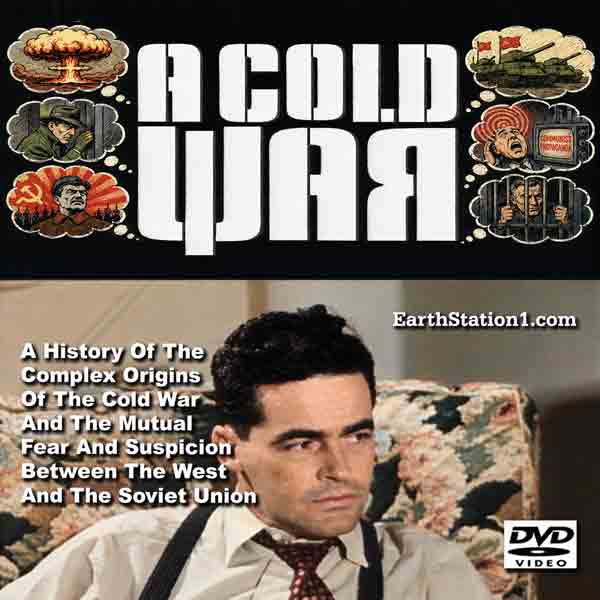
September 4, 1949: Civil Rights
Movements: The American Civil Rights Movement: The American Civil
Rights Movement (1896-1954) (The Jim Crow Era): Anti-Black Racism
In The United States: Organized Labor: The Labor Union Movement:
The Labor Union Movement In The United States: The Aftermath Of
World War II: The Cold War: The Cold War (1947-1953):
Anti-Communism In The United States: The Red Scare: The Second Red
Scare: The Alien Registration Act (The Smith Act): The Peekskill
Riots: -- Anti-communist riots with anti-black and anti-Semitic
undertones break out after a Paul Robeson concert at Cortlandt
Manorin Peekskill, New York. The catalyst for the rioting was an
announced concert by black singer Paul Robeson, who was well known
for his strong pro-trade union stance, civil rights activism,
communist affiliations, and anti-colonialism. The concert,
organized as a benefit for the Civil Rights Congress, was
scheduled to take place on August 27 in Lakeland Acres, just north
of Peekskill. The Civil Rights Congress (CRC) was formed in 1946
at a national conference for radicals and disbanded in 1956. It
succeeded the International Labor Defense, the National Federation
for Constitutional Liberties, and the National Negro Congress,
serving as a defense organization. Beginning about 1948, it became
involved in representing African Americans sentenced to death and
other highly prominent cases, in part to highlight racial
injustice in the United States. After Rosa Lee Ingram and her two
teenage sons were sentenced in Georgia, the CRC conducted a
national appeals campaign on their behalf, their first for African
Americans. On Sale Until Midnight Tonight PT!
https://store.earthstation1.com/a-cold-war-its-origins-amp-mutual-fear-amp-suspicion-dvd-mp4-usb-driv4.html
Today's
EarthStation1.com 15% (Or More!) Off Commemorative Memorial Title:
Television: A History Of Broadcast TV DVD MP4 Download USB Drive
Today, September 4, 2026
September 4, 1951: The Aftermath Of World
War II: The End Of World War II In Asia: World War II: The Pacific
War (The Asia-Pacific War, The Asiatic-Pacific Theater, The
Pacific Theater Of World War II): The Treaty of San Francisco
(Japanese: San-Furanshisuko Kowa-Joyaku) (The Treaty Of Peace With
Japan [Japanese: Nihon-Koku To No Heiwa-Joyaku], The Peace Treaty
Of San Francisco [Japanese: Sanfuranshisuko Heiwa-Joyaku]): The
History Of Broadcasting: The History Of Television Broadcasting:
Television Broadcasting Firsts: Transcontinental Broadcasting:
Transcontinental Television Broadcasting: -- The first live
transcontinental television broadcast takes place in San
Francisco, from the Japanese Peace Treaty Conference. Known
variously as the Treaty of San Francisco, Peace Treaty with Japan,
Treaty of Peace with Japan, Peace Treaty of San Francisco, or San
Francisco Peace Treaty, it was mostly a treaty between Japan and
the Allied Powers, and was officially signed by 48 nations.
According to Article 11 of the Treaty, Japan accepts the judgments
of the International Military Tribunal for the Far East and of
other Allied War Crimes Courts imposed on Japan both within and
outside Japan. This treaty served to officially end Japan'
position as an imperial power, to allocate compensation to Allied
civilians and former prisoners of war who had suffered Japanese
war crimes during World War II, and to end the Allied post-war
occupation of Japan and return sovereignty to that nation. This
treaty made extensive use of the United Nations Charter and the
Universal Declaration of Human Rights to enunciate the Allies'
goals. On Sale Until Midnight Tonight PT!
https://store.earthstation1.com/television-1988-tv-documentary-series-8-shows-4-dual-laye198884.html
Today's
EarthStation1.com 15% (Or More!) Off Commemorative Memorial Title:
School Segregation: Little Rock & Boston MP4 Video Download
DVD
Today, September 4, 2026
September 4, 1957: Civil Rights
Movements: The American Civil Rights Movement (1954-1968):
Anti-Black Racism In The United States: School Segregation: School
Segregation In The United States: The Little Rock Crisis (The
Little Rock Nine): -- Orval Faubus, governor of Arkansas, calls
out the National Guard to prevent African American students, known
as the Little Rock Nine, from enrolling in Little Rock Central
High School. The U.S. Supreme Court had issued its historic and
unanimous Brown v. Board of Education of Topeka, Kansas ruling on
May 17, 1954, declaring that according to the 14th Amendment, all
laws that established segregated schools were unconstitutional,
and it called for the desegregation of all schools throughout the
nation. Governor Faubus defied this decision in preventing the
Little Rock Nine from enrolling in Central High School three years
after the SCOTUS ruling. The students did successfully attend
Central High School after the military intervention of President
Dwight D. Eisenhower, when on September 24, the President ordered
the 101st Airborne Division of the United States Army to Little
Rock (without its black soldiers, who rejoined the division a
month later) to enforce the SCOTUS ruling, and he federalized the
entire 10,000-member Arkansas National Guard, taking it out of the
hands of Faubus. On Sale Until Midnight Tonight PT!
https://store.earthstation1.com/school-segregation-little-rock-amp-boston-mp4-video-download-dv4.html
Today's
EarthStation1.com 15% (Or More!) Off Commemorative Memorial Title:
CIA The Secret Files The Central Intelligence Agency TV Series MP4
DVD
Today, September 4, 2026
September 4, 1970: The Aftermath Of World
War II: The Cold War: The Cold War In South America: Chile: The
History Of Chile:The 1970 Chilean Presidential Election: The
Election Of Salvador Allende As President Of Chile: -- The first
Marxist to be elected president of a Latin American liberal
democracy, and the first Marxist to win the presidency of a Latin
American country through open elections, occurs when Salvador
Allende is elected President of Chile. Salvador Guillermo Allende
Gossens (June 26, 1908 - September 11, 1973) was a Chilean
physician and socialist politician who served as the 29th
president of Chile from November 3, 1970 until his death on
September 11, 1973. Allende's involvement in Chilean politics
spanned a period of nearly forty years, having covered the posts
of senator, deputy and cabinet minister. As a life-long committed
member of the Socialist Party of Chile, whose foundation he had
actively contributed to, he unsuccessfully ran for the national
presidency in the 1952, 1958, and 1964 elections. In 1970, he won
the presidency as the candidate of the Popular Unity coalition, in
a close three-way race. He was elected in a run-off by Congress,
as no candidate had gained a majority. As president, Allende
sought to nationalize major industries, expand education and
improve the living standards of the working class. He clashed with
the right-wing parties that controlled Congress and with the
judiciary. On September 11, 1973, the military moved to oust
Allende in a coup d'etat supported by the United States Central
Intelligence Agency (CIA). As troops surrounded La Moneda Palace,
he gave his last speech vowing not to resign. Later that day,
Allende committed suicide though there has been some controversy
about the cause of his death with some believing it to be an
assassination. Following Allende's death, General Augusto Pinochet
refused to return authority to a civilian government, and Chile
was later ruled by a military junta until 1990, ending more than
four decades of uninterrupted democratic governance. The military
junta that took over dissolved the Congress of Chile, suspended
the Constitution, and began a program of persecuting alleged
dissidents, in which at least 3,095 civilians disappeared or were
killed. On Sale Until Midnight Tonight PT!
https://store.earthstation1.com/cia-the-secret-files-the-central-intelligence-agency-tv-series-mp4-dv4.html
Today's
EarthStation1.com 15% (Or More!) Off Commemorative Memorial Title:
Hollywood The Golden Years: The RKO Story DVD, Download, USB Drive
Today, September 4, 2026
September 4, 1908: #BOTD: #HBD! Edward
Dmytryk, Canadian-American film director and producer, one of the
Hollywood Ten, best known for his 1940s noir films and for
directing The Caine Mutiny (1954), a critical and commercial
success, the second highest-grossing film of the year and
nominated for Best Picture and several other awards at the 1955
Oscars (d. July 1, 1999) is #born in Grand Forks, British
Columbia, Canada to Ukrainian immigrant parents Frances
(Berezowski) and Michael Dmytryk. Edward Dmytryk received an Oscar
nomination for Best Director for Crossfire (1947). Also in 1947 he
was named as one of the Hollywood Ten, a group of blacklisted film
industry professionals who refused to testify to the House
Un-American Activities Committee (HUAC) in their investigations
during the McCarthy-era 'Red scare'. They all served time in
prison for contempt of Congress. In 1951, however, Dmytryk did
testify to HUAC and rehabilitated his career. First hired again by
independent producer Stanley Kramer in 1952, Dmytryk is likely
best known for directing The Caine Mutiny (1954), a critical and
commercial success. The second highest-grossing film of the year,
it was nominated for Best Picture and several other awards at the
1955 Oscars. Dmytryk was nominated for a Directors Guild Award for
Outstanding Directorial Achievement in Motion Pictures. Edward
Dmytryk died at age 90 in Encino, California of heart and kidney
failure. He is buried at the Forest Lawn Memorial Park, in
Hollywood, California. On Sale Until Midnight Tonight PT!
https://store.earthstation1.com/hollywood-the-golden-years-the-rko-story-dvd-set-2-disc2.html
Today's
EarthStation1.com 15% (Or More!) Off Commemorative Memorial Title:
Ten From Your Show Of Shows - Sid Caesar TV Series DVD, Download,
USB
Today, September 4, 2026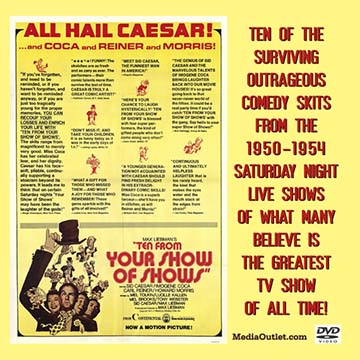
September 4, 1919: #BOTD: #HBD! Howard
Morris, American actor, director, comedian, voice actor and
screenwriter, best known for his role in The Andy Griffith Show as
Ernest T. Bass, and as "Uncle Goopy" in a celebrated
comedy sketch on Sid Caesar's Your Show of Shows (1954 (d. May 21,
2005) is #born Howard Jerome Morris to a Jewish family in the
Bronx, New York. Howard Morris also did some voices for TV shows
such as The Flintstones (1962-1965), The Jetsons (1962-1987), The
Atom Ant Show (1965-1966), Garfield and Friends (1988-1994) and
Cow And Chicken (1997-1999). Howard Morri died of congestive heart
failure in Los Angeles, California at the age of 85. At his
funeral, the "Uncle Goopy" sketch was shown; among the
eulogizers was Carl Reiner, who praised Morris' ability to
improvise. He is entombed in Laurel Gardens Wall crypt at Hillside
Memorial Park Cemetery in Culver City, California. On Sale Until
Midnight Tonight PT!
https://store.earthstation1.com/ten-from-your-show-of-shows-tv-show-movie-dvd.html
Today's
EarthStation1.com 15% (Or More!) Off Commemorative Memorial Title:
Bloopers: Radio & TV Outtakes CD, MP3 Audio Download, USB
Flash Drive
Today, September 4, 2026
September 4, 1918: #BOTD: #HBD! Paul
Harvey, American radio host, conservative radio broadcaster for
ABC News Radio (d. February 28, 2009) is #born Paul Harvey Aurandt
born in Tulsa, Oklahoma. He broadcast News and Comment on weekday
mornings and mid-days and at noon on Saturdays, as well as his
famous The Rest of the Story segments. From 1952 through 2008, his
programs reached as many as 24 million people per week. Paul
Harvey News was carried on 1,200 radio stations, 400 American
Forces Network stations, and 300 newspapers. Paul Harvey died at
age 90 at a hospital in Phoenix, Arizona, surrounded by family and
friends. No cause of death was ever been announced. He is buried
at Forest Home Cemetery in Forest Park, Illinois. On Sale Until
Midnight Tonight PT!
https://store.earthstation1.com/bloopers-outtakes-and-offmoments-radio-and-tv-madness-mp3-c3.html
Today's
EarthStation1.com 15% (Or More!) Off Commemorative Memorial Title:
Teenagers! Classic Youth Social Guidance Films DVD, MP4, USB Drive
Today, September 4, 2026
September 4, 1928: #BOTD: #HBD! Dick
York, American radio, stage, film, and television actor, best
remembered for his role as the first Darrin Stephens on the ABC
fantasy sitcom Bewitched, and whose best-known motion-picture role
was as teacher Bertram Cates in the film Inherit the Wind (1960)
(d. February 20, 1992) is #born Richard Allen York in Fort Wayne,
Indiana, to Betty, a seamstress, and Bernard York, a salesman.
Dick York grew up in Chicago, where a Catholic nun first
recognized his vocal promise. He began his career at the age of 15
as the star of the CBS radio program That Brewster Boy. He also
appeared in hundreds of other radio shows and instructional films
before heading to New York City, where he acted on Broadway in Tea
and Sympathy and Bus Stop. He performed with stars including Paul
Muni and Joanne Woodward in live television broadcasts and with
Janet Leigh, Jack Lemmon, and Glenn Ford in movies, including My
Sister Eileen and Cowboy. While filming the movie They Came to
Cordura (1959) with Gary Cooper and Rita Hayworth, he suffered a
permanent, disabling back injury. In York's own words, "Gary
Cooper and I were propelling a handcar carrying several 'wounded'
men down [the] railroad track. I was on the bottom stroke of this
sort of teeter-totter mechanism that made the handcar run. I was
just lifting the handle up as the director yelled 'cut!' and one
of the 'wounded' cast members reached up and grabbed the handle.
Now, instead of lifting the expected weight, I was suddenly,
jarringly, lifting his entire weight off the flatbed-180 pounds or
so. The muscles along the right side of my back tore. They just
snapped and let loose. And that was the start of it all: the pain,
the painkillers, the addiction, the lost career." York's
injury did not immediately end his career. In 1960, a year after
York's injury, he played Bertram Cates (modeled on John Thomas
Scopes, of "Monkey Trial" fame) in the film version of
Inherit the Wind. York went on to star with Gene Kelly and Leo G.
Carroll in the ABC comedy-drama Going My Way (1962). York was cast
in the series, which lasted one season, as Tom Colwell, who
operates a secular youth center. York appeared in dozens of
episodes of now-classic television series, including Justice, The
Alfred Hitchcock Hour, The Untouchables, Rawhide, The Americans,
Wagon Train, Father Knows Best, and CBS's The Twilight Zone and
Route 66. York was cast as Darrin Stephens in the 1960s sitcom
Bewitched as Samantha's (Elizabeth Montgomery) mortal husband. The
show was a huge success and York was nominated for an Emmy Award
in 1968. The crew built York a slanted wall for him to lean on in
between scenes, which, during the first two seasons, allowed York
to manage his back injury with little difficulty. Halfway through
the third season, York's back injury was aggravated into a painful
degenerative spine condition, frequently causing shooting delays
while York required assistance to walk around. Sometimes, York
would seize up in debilitating pain, so the scripts for some of
his later episodes on Bewitched were written around his being in
bed or on the couch for the entire episode. York did not appear in
a handful of seasons-three and four episodes, and by halfway
through season five, was barely appearing at all, causing the
series to focus more on Samantha and other members of her family,
with mentions that Darrin was away on business. While filming the
fifth-season episode "Daddy Does His Thing", York fell
ill: "I was too sick to go on. I had a temperature of 105,
full of strong antibiotics, for almost 10 days. I went to work
that day, but I was sick. I lay in my dressing room after being in
make-up, waiting to be called on the set. They knew I was feeling
pretty rotten, and they tried to give me time to rest. I kept
having chills. This was the middle of the summer and I was wearing
a sheepskin jacket and I was chilling. I was shaking all over.
Then, while sitting on a scaffolding with Maurice Evans, being lit
for a special-effects scene: They were setting an inky - that's a
little tiny spot[light] that was supposed to be just flickering
over my eyes. That flickering, flickering, flickering made me feel
weird. And I'm sitting on this platform up in the air...and I
turned to Gibby, who was just down below, and I said, 'Gibby, I
think I have to get down.' He started to help me down and that's
the last thing I remember until I woke up on the floor. That's
about all I remember of the incident...and I'd managed to bite a
very large hole in the side of my tongue before they could pry my
teeth apart." From York's hospital bed, director William
Asher and he discussed York's future. "Do you want to quit?"
Asher asked. "If it's all right with you, Billy," York
replied. With that, York left the sitcom to devote himself to
recovery. He never again returned to the set. Dick Sargent
replaced York in the role of Darrin Stephens, taking over the role
at the start of the series' sixth season (1969-1970) and
continuing in the part until the series ended after its eighth
season (1971-1972). Sargent was originally offered the role of
Darrin in 1964, but turned it down to do a short-lived sitcom
called Broadside. For the next 18 months, York was largely
bed-ridden in a haze of prescription painkillers. In his memoir,
The Seesaw Girl and Me, published posthumously, he describes the
struggle to break his addiction and come to grips with the loss of
his career. The book is in large part a love letter to his wife,
Joan (nee Alt), the seesaw girl of the title, who stuck with him
through the hard times. He then quit drugs cold turkey, which led
to six months of difficult withdrawal and recovery. "I had a
band playing in my head, bagpipes night and day," York
recalled. "It just went on and on and on and on and on... The
fans whisper to you and the walls whisper to you and you look at
television and sometimes it flashes in a certain way that sends
you into a fit and you know that your wife has put her hand in
your mouth so you won't bite off your tongue. You can't sleep. You
hallucinate. I used to make a tape recording of rain so I could
listen to the rain lying in bed at night to drown out those damned
bagpipes." York eventually beat his addiction, and in the
early 1980s tried to revive his career. His last two credits were
on two primetime television series, Simon & Simon and Fantasy
Island. York was a three-pack-a-day smoker for much of his life
and often smoked cigarettes on the set of Bewitched; he spent his
final years battling emphysema. By 1989, he was using an oxygen
tank to help him breathe. While bedridden in his Rockford,
Michigan, home, he founded Acting for Life, a private charity to
help the homeless and others in need. Using his telephone as his
pulpit, York motivated politicians, business people, and the
general public to contribute supplies and money. Despite his
suffering, York said, "I've been blessed. I have no
complaints. I've been surrounded by people in radio, on stage, and
in motion pictures and television who love me. The things that
have gone wrong have been simply physical things." York died
of complications from emphysema at Blodgett Hospital in East Grand
Rapids, Michigan, on February 20, 1992, at age 63. He is buried in
Plainfield Cemetery in Rockford, Michigan. On Sale Until Midnight
Tonight PT!
https://store.earthstation1.com/teenagers-classic-youth-social-guidance-films-dvd-set-2-disc2.html
Today's
EarthStation1.com 15% (Or More!) Off Commemorative Memorial Title:
Mo' Funny: Black Comedy In America DVD Video Download
Today, September 4, 2026
September 4, 1960: #BOTD: #HBD! Damon
Wayans, African American actor, comedian, producer, and writer, is
#born Damon Kyle Wayans in Harlem, New York City, the son of
Elvira Alethia (Green), a homemaker, singer and social worker, and
Howell Stouten Wayans, a supermarket manager. Wayans performed as
a comedian and actor throughout the 1980s, including a year long
stint on the sketch comedy series Saturday Night Live. His true
breakthrough, however, came as writer and performer on FOX's
sketch comedy show In Living Color from 1990 to 1992, his animated
series Waynehead that ran on the Kids' WB block from 1996 to 1997,
and his TV series Damon (1998). Since then, he has starred in a
number of films and television shows, some of which he has
co-produced or co-written, including Beverly Hills Cop, The Last
Boy Scout, and Major Payne and the sitcom My Wife and Kids. From
2016 to 2019, he starred as Roger Murtaugh in the television
series Lethal Weapon. He is a member of the Wayans family of
entertainers. On Sale Until Midnight Tonight PT!
https://store.earthstation1.com/mo39-funny-black-comedy-in-america-dvd-video-downlo39.html
Today's
EarthStation1.com 15% (Or More!) Off Commemorative Memorial Title:
Robert E. Lee Documentaries DVD, MP4 Video Dowload, USB Flash
Drive
Today, September 4, 2026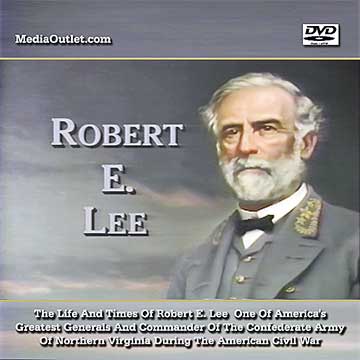
September 4, 1862: The American Civil War
(The Civil War, The War Between The States): The Eastern Theater
Of The American Civil War: The Maryland Campaign (The Antietam
Campaign): -- General Robert E. Lee leads his Army Of Northern
Virginia in the war's first Confederate invasion of the American
North, marking the beginning of The Maryland Campaign which would
last until September 20. Following his victory in the Northern
Virginia Campaign, Lee moved north with 55,000 men through the
Shenandoah Valley starting on September 4, 1862. He and his forces
were repulsed by The Army Of The Potomac under Maj. Gen. George B.
McClellan, who moved to intercept Lee and his Army Of Northern
Virginia, and who eventually attacked it near Sharpsburg,
Maryland. The resulting Battle Of Antietam (known as The Battle Of
Sharpsburg in the South) was the bloodiest single-day battle in
American history with over 22,000 casualties, and is widely
considered one of the major turning points of the war. Lee's
objective was to resupply his army from outside of the war-torn,
supply-depleted Virginia theater, and to damage Northern morale in
anticipation of the November elections. He undertook the risky
maneuver of splitting his army so that he could continue north
into Maryland while simultaneously capturing the Federal garrison
and arsenal at Harpers Ferry, the site of John Brown's failed
insurrection which sparked a long fuse of towards the outbreak of
The Civil War. McClellan accidentally found a copy of Lee's orders
to his subordinate commanders, and used it in a plan to isolate
and defeat the separated portions of Lee's army. While Confederate
Maj. Gen. Stonewall Jackson surrounded, bombarded, and captured
Harpers Ferry (September 12-15), McClellan's army of 102,000 men
attempted to move quickly through the South Mountain passes that
separated him from Lee. The Battle of South Mountain on September
14 delayed McClellan's advance and allowed Lee sufficient time to
concentrate most of his army at Sharpsburg. The Battle Of Antietam
was fought three days later. Lee, outnumbered two to one, moved
his defensive forces to parry each offensive blow, but McClellan
never deployed all of the reserves of his army to capitalize on
localized successes and destroy the Confederates. On September 18,
Lee ordered a withdrawal across the Potomac river, and on
September 19-20, fighting by Lee's rear guard at Shepherdstown
ended The Maryland Campaign. Although Antietam was a tactical
draw, it strategic defeat of Lee's Maryland Campaign. President
Abraham Lincoln used this Union victory as the justification for
announcing his Emancipation Proclamation, which effectively ended
any threat of European support for the Confederacy. On Sale Until
Midnight Tonight PT!
https://store.earthstation1.com/robert-e-lee-documentaries-dvd.html
Today's
EarthStation1.com 15% (Or More!) Off Commemorative Memorial Title:
Lighter Than Air: Airships & Inflatable Planes DVD, MP4, USB
Drive
Today, September 4, 2026
September 4, 1923: Aviation: The History
Of Aviation: The History Of Military Aviation: Maiden Flights: --
The first U.S. airship, the USS Shenandoah, the United States'
first American-built rigid airship, makes its first flight, taking
to the air from Lakehurst Naval Air Station where it was
constructed during 1922-23. USS Shenandoah was the first of four
United States Navy rigid airships. It developed the U.S. Navy's
experience with rigid airships, and made the first crossing of
North America by airship. It was destroyed on her 57th flight in a
squall line of thunderstorms over Noble County, Ohio on September
3, 1925. Fourteen of her 42-man crew perished, including her
commander, Zachary Lansdowne. On Sale Until Midnight Tonight PT!
https://store.earthstation1.com/lighter-than-air-airships-inflatable-planes-dvd-mp3-us3.html
Today's
EarthStation1.com 15% (Or More!) Off Commemorative Memorial Title:
Civil Jets The Boeing 707 C135 Stratolifter KC135 Tanker DVD, MP4,
USB
Today, September 4, 2026
September 4, 1971: Aviation: The History
Of Aviation: The History Of Civil Aviation: Aviation Incidents And
Accidents: Alaska Airlines Flight 1866: -- #DOTD: #RIP: A
regularly scheduled passenger flight operated by Alaska Airlines
from Anchorage, Alaska, to Seattle, Washington ends when its
Boeing 727-100 airliner crashed into a mountain in Haines Borough,
Alaska about 18 miles west of Juneau while on approach for
landing. All 111 people aboard were killed. The subsequent
investigation found that erroneous navigation readouts led the
crew to descend prematurely. No definitive cause for the
misleading data was found. It was the first fatal jet aircraft
crash involving Alaska Airlines, and remained the deadliest
single-aircraft accident in United States history until June 24,
1975, when Eastern Air Lines Flight 66 crashed, and it remains the
worst air disaster in Alaska state history. On Sale Until Midnight
Tonight PT!
https://store.earthstation1.com/civil-jets-the-boeing-707-c135-stratolifter-kc135-t707135135.html
Today's
EarthStation1.com 15% (Or More!) Off Commemorative Memorial Title:
The Birth Of Europe: Ice Age To 20th Century DVD, Video Download,
USB
Today, September 4, 2026
September 4, 1666: Natural Disasters:
Natural Disasters In England: Natural Disasters In London: Fires:
Fires In England: Fires In London: Conflagrations: Conflagrations
In England: Conflagrations In London: The Great Fire Of London
(The First Great Fire Of London): -- The most destructive damage
from the Great Fire occurs as the fire continues to rage. The
Great Fire Of London was a major conflagration that swept through
the central parts of the English city of London from Sunday,
September 2 to Wednesday, September 5, 1666. The fire gutted the
medieval City of London inside the old Roman city wall. It
threatened but did not reach the aristocratic district of
Westminster, Charles II' Palace Of Whitehall, and most of the
suburban slums. It consumed 13,200 houses, 87 parish churches, St
Paul' Cathedral, and most of the buildings of the City
authorities. It is estimated to have destroyed the homes of 70,000
of the City' 80,000 inhabitants. The death toll is unknown but
traditionally thought to have been small, as only six verified
deaths were recorded. This reasoning has recently been challenged
on the grounds that the deaths of poor and middle-class people
were not recorded, while the heat of the fire may have cremated
many victims, leaving no recognisable remains. A melted piece of
pottery on display at the Museum of London found by archaeologists
in Pudding Lane, where the fire started, shows that the
temperature reached 1250 degrees Celsius. On Sale Until Midnight
Tonight PT!
https://store.earthstation1.com/the-birth-of-europe-european-history-from-the-ice-age-to-20th-centu20.html
Today's
EarthStation1.com 15% (Or More!) Off Commemorative Memorial Title:
Cavalcade Of America US History Radio Drama Series DVD, Download,
USB
Today, September 4, 2026
September 4, 1886: The American Indian
Wars (The American Frontier Wars, The Indian Wars): The Apache
Wars: The Geronimo Campaign: The Surrender Of Geronimo: -- After
almost 30 years of fighting, Apache leader Geronimo, with his
remaining warriors, surrenders to General Nelson Miles in Arizona.
Geronimo was a prominent leader and medicine man from the
Bedonkohe band of the Chiricahua Apache tribe. From 1850 to 1886
Geronimo joined with members of three other Chiricahua Apache
bands-the Tchihende, the Tsokanende and the Nednhi-to carry out
numerous raids as well as resistance to US and Mexican military
campaigns in the northern Mexico states of Chihuahua and Sonora,
and in the southwestern American territories of New Mexico and
Arizona. Geronimo' raids and related combat actions were a part of
the prolonged period of the Apache-United States conflict, which
started with American settlement in Apache lands following the end
of the war with Mexico in 1848. While well known, Geronimo was not
a chief among the Chiricahua or the Bedonkohe band. At any one
time, about 30 to 50 Apaches would be following him. However,
since he was a superb leader in raiding and warfare he frequently
led large numbers of men and women beyond his own following.
During his final period of conflict from 1876 to 1886 he
"surrendered" three times and accepted life on the
Apache reservations in Arizona. In his old age, Geronimo became a
celebrity. He appeared at fairs, including the 1904 World' Fair in
St. Louis, where he rode a ferris wheel, sold souvenirs and
photographs of himself. He died at the Fort Sill hospital in 1909,
still a prisoner of war. US Paratroopers beginning in 1940
famously began using the battle cry "Geronimo" when
jumping from a plane. On Sale Until Midnight Tonight PT!
https://store.earthstation1.com/cavalcade-of-america-historical-old-time-radio-mp3-dv3.html
Today's
EarthStation1.com 15% (Or More!) Off Commemorative Memorial Title:
The Yom Kippur War: The 1973 Arab-Israeli War MP4 Video Download
DVD
Today, September 4, 2026
September 4, 1975: The Cold War: The Arab Cold War (July 23, 1952 - February 11, 1979): The Arab-Israeli Conflict: The Israeli-Palestinian Conflict: The Yom Kippur War (The Ramadan War, The October War, The 1973 Arab-Israeli War, The Fourth Arab-Israeli War): The Aftermath Of The Yom Kippur War: The Arab-Israeli Peace Process: The Egyptian-Israeli Peace Process: The Sinai Interim Agreement (The Sinai II Agreement): -- Egypt and Israel sign a diplomatic agreement in Geneva, Switzerland to peacefully resolving territorial disputes between the two countries so thaty they "shall not be resolved by military force but by peaceful means." It also called "for a further withdrawal in the Sinai and a new UN buffer zone." Thus, the agreement strengthened Israel's and Egypt's commitment to abiding by U.N. Resolution 338 and strengthened diplomatic relations between Egypt, Israel, and the United States. The purpose of this agreement, in the eyes of the Egyptians, was to gain back as much of the Sinai Peninsula (which had been occupied by Israel since 1967) as they could through diplomacy. Although the agreement strengthened Egypt's relationship with the Western world, it diminished its relationships with other members of the Arab League, especially Syria and the Palestine Liberation Organization. On Sale Until Midnight Tonight PT! https://store.earthstation1.com/yomkiwa19arw.html
Today's
EarthStation1.com 15% (Or More!) Off Commemorative Memorial Title:
1940-1960: Empires Crumble - End Of World Colonialism DVD, MP4,
USB
Today, September 4, 2026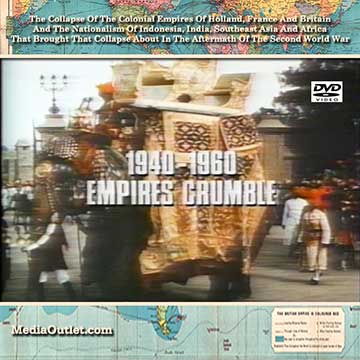
September 4, 1948: The Monarchy Of The
Netherlands (The Dutch Monarchy): Royal Abdications: -- Royal
Abdications: Queen Wilhelmina Of The Netherlands, Queen Of The
Netherlands since from 1890, dismayed by the return to pre-war
politics and the pending loss of Indonesia, abdicates after a
reign of 57 years and 286 days due to advancing age and illness.
She passed the crown to her daughter, Princess Juliana of the
Netherlands, and was hence forward styled "Her Royal Highness
Princess Wilhelmina Of The Netherlands". Since then, the
influence of the Dutch monarchy continued to decline but the
country's love for its royal family continued. Wilhelmina Of The
Netherlands (August 31, 1880 - November 28, 1962) was born
Wilhelmina Helena Pauline Maria in Noordeinde Palace, The Hague,
Netherlands. She was the only child of King William III and Emma
of Waldeck and Pyrmont. Wilhelmina reigned for nearly 58 years,
longer than any other Dutch monarch. Her reign saw both World War
I and World War II, as well as the Dutch economic crisis of 1933.
Wilhelmina ascended to the throne at the age of 10 after her
father's death in 1890, under her mother's regency. After taking
charge of government, Wilhelmina became generally popular for
maintaining Dutch neutrality during the First World War and
solving many of her country's industrial problems. By that time,
her business ventures had made her the world's first female
billionaire in dollars. She went on to ensure that her family was
one of seven European royal houses remaining in existence.
Following the German invasion of the Netherlands in 1940,
Wilhelmina fled to Britain and took charge of the Dutch
government-in-exile. She frequently spoke to the nation over radio
and came to be regarded as a symbol of the resistance although she
was criticised for failing to acknowledge some of the atrocities
such as the Bombing of Nijmegen. By 1948, she had returned to the
liberated Netherlands and was the only survivor of the 16 monarchs
who were sitting on their thrones at the time of her coronation.
Increasingly beset by poor health, Wilhelmina abdicated in favour
of her daughter Juliana in September 1948 and retired to Het Loo
Palace, where she died in 1962. She remains generally popular in
the Netherlands, even among the Dutch Republican movement. This is
due to her being seen as a symbol of Dutch Resistance during World
War II. On Sale Until Midnight Tonight PT!
https://store.earthstation1.com/19401960-empires-crumble--end-of-world-colonialism--dv194019604.html
Today's
EarthStation1.com 15% (Or More!) Off Commemorative Memorial Title:
Rodgers And Hammerstein: The Sound Of American Music DVD, MP4, USB
Today, September 4, 2026
September 4, 1931: #BOTD: #HBD! Mitzi
Gaynor, American actress, singer, dancer and beauty, is #born
Francesca Marlene de Czanyi von Gerber in Chicago, Illinois, the
daughter of Pauline, a dancer, and Henry de Czanyi von Gerber, a
violinist, cellist, and music director. Her notable films include
There's No Business Like Show Business (1954) and South Pacific,
the 1958 motion picture adaptation of the stage musical by Rodgers
and Hammerstein. After her father remarried, she became
step-sister to anti-war activist Donald W. Duncan, a U.S. Army
Special Forces soldier who served during the Vietnam War, helping
to establish the guerrilla infiltration force Project DELTA there.
Following his return to the United States, Duncan became one of
the earliest military opponents of the war and one of the antiwar
movement leading public figures. Duncan is best remembered as the
cover image on the February 1966 issue of Ramparts where he
announced "I quit", as well as for his testimony to the
1967 Russell Tribunal detailing American war crimes in Vietnam.
Her family first moved to Elgin, Illinois, and then to Detroit,
and later when she was eleven, on to Hollywood. She trained as a
ballerina as a child and began her career in the corps de ballet.
At 13, she was singing and dancing with the Los Angeles Civic
Light Opera company. She lied about her address so she could
attend Le Conte Junior High in Hollywood. She signed a seven-year
contract with Twentieth Century-Fox at age 17. She sang, acted,
and danced in a number of film musicals, often paired with some of
the biggest male musical stars of the day. A Fox Studio executive
thought that Mitzi Gerber sounded like the name of a delicatessen,
and they came up with a name that used the same initials. Gaynor
made her film debut in a musical, My Blue Heaven (1950) supporting
Betty Grable and Dan Dailey. She followed it with a college drama
Take Care of My Little Girl (1951), where she played the roommate
of Jeanne Crain. Fox then gave Gaynor a star part, in the musical
biopic Golden Girl (1951), playing Lotta Crabtree. It was a mild
success at the box office. Gaynor was one of several stars in the
anthology comedy We're Not Married! (1952), then she was top
billed in the musical, Bloodhounds of Broadway (1952), which made
2M USD. Fox put her in another biopic, The I Don't Care Girl
(1952), where she played Eva Tanguay. The film made 1.25M USD.
Gaynor starred in Down Among the Sheltering Palms (1953), playing
a South Sea island girl. She was the female lead in a Western,
Three Young Texans (1954). Gaynor's most popular film in her time
at Fox was Irving Berlin's There's No Business Like Show Business
(1954), where she was billed after Ethel Merman, Dan Dailey,
Marilyn Monroe, Donald O'Connor and Johnnie Ray. Gaynor married
Jack Bean, a talent agent and public relations executive for MCA,
in San Francisco, California, on November 18, 1954. They resided
on North Arden Drive in Beverly Hills, California. She had just
been released from Twentieth Century-Fox (before the start of
There's No Business Like Show Business) with four years left on
her contract and decided with the time off to get married. The
union was childless. After their marriage, Bean quit MCA and
started his publicity firm called Bean & Rose and managed
Gaynor's career. In 1956, Gaynor appeared in the Paramount remake
of Anything Goes, co-starring Bing Crosby, Donald O'Connor, and
Zizi Jeanmaire, loosely based on the musical by Cole Porter, P.G.
Wodehouse and Guy Bolton. Paramount cast her in another remake,
The Birds and the Bees (1956), playing the role originated by
Barbara Stanwyck in The Lady Eve (1941). Her third film for
Paramount was The Joker Is Wild (1957), a biopic of Joe E. Lewis
starring Frank Sinatra, in which Gaynor played the female lead. In
1957, Gaynor appeared in MGM's Les Girls, directed by George
Cukor, with Gene Kelly and Kay Kendall. Her biggest international
fame came from her starring role as Ensign Nellie Forbush in the
film version of Rodgers and Hammerstein's South Pacific. For her
performance, she was nominated for a Best Actress Golden Globe
Award. Gaynor followed this with a comedy at MGM, Happy
Anniversary (1959) opposite David Niven, and the United Kingdom
production Surprise Package (1960), a musical comedy thriller
directed by Stanley Donen. Her co-stars were Yul Brynner and Noel
Coward. The film had a theme song by Jimmy Van Heusen and Sammy
Cahn. Her last film role was For Love or Money (1963), starring
Kirk Douglas. Following her film work, Gaynor performed in other
media. She appeared between two sets by The Beatles when they made
their second appearance on The Ed Sullivan Show on February 16,
1964. She performed for a nine-minute segment from the stage of
the Deauville Hotel, in Miami Beach, separated by one commercial
break. She sang "Too Darn Hot" and a blues medley. At
the 1967 Academy Awards ceremony, she sang the theme from the film
Georgy Girl. Gaynor later added the number to her concert
repertoire. Through the 1960s and 1970s, she starred in nine
television specials that garnered 16 Emmy nominations. Gaynor
recorded two albums for the Verve Records label, one called Mitzi
and the second called Mitzi Gaynor Sings the Lyrics of Ira
Gershwin. She is thought to have earned more from the record
royalties on the South Pacific soundtrack album than her salary
for the movie. She also recorded the title song from her film
Happy Anniversary for the Top Rank label. For several decades,
Gaynor appeared regularly in Las Vegas and at nightclub and
concert venues throughout the United States and Canada. During the
1990s, Gaynor became a featured columnist for the newsmagazine The
Hollywood Reporter. During her nightclub years, Gaynor developed
and rehearsed her routines at The Cave, a club in Vancouver. She
became fond of the city and frequently made guest appearances on
local television for interviews. "Mitzi's back in town"
became an annual slogan when Gaynor would come to the city for a
number of weeks each year to develop her Las Vegas routines. On
December 4, 2006, Jack Bean, Gaynor's husband of 52 years, died of
pneumonia in the couple's Beverly Hills, California, home, aged
84. A producer and personal manager, Bean guided Gaynor's career.
On July 30, 2008, Gaynor - along with Kenny Ortega, Elizabeth
Berkley, Shirley MacLaine, and cast members from High School
Musical, So You Think You Can Dance, Dancing with the Stars, and
others - participated in the Academy of Television Arts and
Sciences TV Moves Live, a celebration of 60 years of dance on
television. Gaynor appeared performing the final few bars of "Poor
Papa", a song-and-dance number from her 1969 TV special,
Mitzi's 2nd Special. Four months later, on November 18, 2008, City
Lights Pictures released Mitzi Gaynor Razzle Dazzle: The Special
Years, a documentary celebrating Gaynor's annual television
specials of the 1960s and 1970s. The film, which was broadcast on
public television and released on DVD, includes moments from the
original specials (digitally remastered in 5.1 stereo) along with
newly taped interviews with Gaynor colleagues, friends, and
admirers, including Bob Mackie, Carl Reiner, Kristin Chenoweth,
Rex Reed, Tony Charmoli, Alton Ruff, Randy Doney, and Kelli
O'Hara. Gaynor's one-woman show, Razzle Dazzle: My Life Behind the
Sequins, toured the United States and Vancouver from 2009 thru
2014, including a two-week engagement in New York City. Mitzi
Gaynor died in Los Angeles, California from natural causes in Los
Angeles on October 17, 2024 at the age of 93. She is buried at
Forest Lawn Memorial Park in Glendale, California. On Sale Until
Midnight Tonight PT!
https://store.earthstation1.com/rodgers-and-hammerstein-the-sound-of-american-music-dvd-dvd-mp4-us4.html
Today's
EarthStation1.com #OnThisDay Commemorative Memorial Title: The
Western Tradition TV Series DVD, MP4 Video Download, USB Drive
Today, September 4, 2026 September 4, 1870: The Unification Of
Germany (German: Deutsche Einigung): The Franco-Prussian War (The
Franco-German War, The War Of 1870): The Battle Of Sedan: The
Deposition Of Emperor Napoleon III Of France: -- Having suffered a
humiliating defeat and capture by the Germans, Napoleon III,
having left for a comfortable captivity in Schloss Wilhelmshohe
near Kassel, Germany, is deposed as head of The French Second
Republic as Napoleon's soldiers, who viewed his departure with
indifference, marched under heavy rain to an improvised German POW
camp, where they starved for the next week. The capture of the
French emperor left the Prussians without an opposing government
willing to make a quick peace. Commenting on the difficult
situation, two days after news hit Paris of Emperor Napoleon III's
capture, his wife said, "Why didn't he kill himself?"
The same day, a group of protesters stormed the Imperial palace
and the Second French Empire collapsed in a bloodless revolution,
leading to the creation of a Government of National Defense which
would carry on the war for five more months before becoming the
French Third Republic. The defeat at Sedan and the capture of
Napoleon III and France's second line army, and with the first
line French Army shut up in Metz, sealed the doom of France, thus
decided the outcome of the war in Prussia's favor. By September
19, the Prussian Third and Fourth Armies went on to besiege Paris.
In recognition of the role this battle played in German
Unification, many Germans celebrated Sedantag (Day of Sedan) on
each September 2 until 1919. The Kaiser himself refused to declare
September 2 an official holiday; instead, it became an unofficial
day of celebration.
https://store.earthstation1.com/the-western-tradition-dvd-set-all-52-shows-13-d5213.html
September 4, 1870: The Unification Of
Germany (German: Deutsche Einigung): The Franco-Prussian War (The
Franco-German War, The War Of 1870): The Battle Of Sedan: The
Deposition Of Emperor Napoleon III Of France: -- Having suffered a
humiliating defeat and capture by the Germans, Napoleon III,
having left for a comfortable captivity in Schloss Wilhelmshohe
near Kassel, Germany, is deposed as head of The French Second
Republic as Napoleon's soldiers, who viewed his departure with
indifference, marched under heavy rain to an improvised German POW
camp, where they starved for the next week. The capture of the
French emperor left the Prussians without an opposing government
willing to make a quick peace. Commenting on the difficult
situation, two days after news hit Paris of Emperor Napoleon III's
capture, his wife said, "Why didn't he kill himself?"
The same day, a group of protesters stormed the Imperial palace
and the Second French Empire collapsed in a bloodless revolution,
leading to the creation of a Government of National Defense which
would carry on the war for five more months before becoming the
French Third Republic. The defeat at Sedan and the capture of
Napoleon III and France's second line army, and with the first
line French Army shut up in Metz, sealed the doom of France, thus
decided the outcome of the war in Prussia's favor. By September
19, the Prussian Third and Fourth Armies went on to besiege Paris.
In recognition of the role this battle played in German
Unification, many Germans celebrated Sedantag (Day of Sedan) on
each September 2 until 1919. The Kaiser himself refused to declare
September 2 an official holiday; instead, it became an unofficial
day of celebration.
https://store.earthstation1.com/the-western-tradition-dvd-set-all-52-shows-13-d5213.html
Today's
EarthStation1.com #OnThisDay Commemorative Memorial Title: The
World At War 1942 How WWII Started Documentary DVD, Download, USB
Today, September 4, 2026September 4, 1939: The European Civil
War: World War II: The Second European War (The European Theater
Of World War II): Aviation: Military Aviation: Air Warfare Of
World War II: -- A Bristol Blenheim is the first British aircraft
to cross the German coast following the declaration of war and
German ships are bombed. The Bristol Blenheim is a British light
bomber aircraft designed and built by the Bristol Aeroplane
Company that was used extensively in the first two years of the
Second World War. The Type 142 first flew in April 1935, and the
Air Ministry, impressed by its performance, ordered a modified
design as the Type 142M to serve in the Royal Air Force (RAF) as a
bomber. Deliveries of the newly named Blenheim to RAF squadrons
commenced on the 10th of March 1937. The Blenheim was one of the
first British aircraft to feature an all-metal stressed-skin
construction, retractable landing gear, flaps, a powered gun
turret and variable-pitch propellers. The design of the Blenheim
proved to be readily adaptable, and was modified to serve in roles
such as an interim long-range fighter and as a night fighter,
pending the availability of a more advanced fighter derivative of
the Blenheim, the Beaufighter. A more capable bomber derivative,
the Beaufort, was also developed, being both larger and heavier
than the Blenheim.
https://store.earthstation1.com/the-world-at-war-dvd-1942-motion-pic1942.html
Today's
EarthStation1.com #OnThisDay Commemorative Memorial Title: Henry
Ford: Tin Lizzie Tycoon + Bonus Film DVD, Download, USB Drive
Today, September 4, 2026September 4, 1917: #BOTD: #HBD! Henry
Ford II, nicknamed "HF2", "Hank The Deuce" or
simply "The Deuce", American automotive industry
businessman, eldest son of Edsel Ford and eldest grandson of Henry
Ford, president of the Ford Motor Company from 1945 to 1960, its
chief executive officer (CEO) from 1945 to 1979, and its chairman
of the board of directors from 1960 to 1980 (d. September 29,
1987) is #born in Detroit, Michigan. Under the leadership of Henry
Ford II, Ford Motor Company became a publicly traded corporation
in 1956. From 1943 to 1950, he also served as president of the
Ford Foundation. Henry Ford II died of pneumonia in Detroit at
Henry Ford Hospital at age 70. After a private funeral service at
Christ Church Grosse Pointe, his remains were cremated, and his
ashes were scattered on The Detroit River.
https://store.earthstation1.com/henry-ford-tin-lizzie-tycoon-dvd-documentary.html
Today's
EarthStation1.com #OnThisDay Commemorative Memorial Title: The
American Adventure: TV History Series 1607-1876 DVD MP4 USB Drive
Today, September 4, 2026September 4, 1812: The Anglo-French Wars
(1109-1815): The Second Hundred Years' War (1689-1815): The United
States And The French Revolutionary And Napoleonic Wars: The Sixty
Years' War (French: Guerre De Soixante Ans) (1754-1815): The
American Indian Wars (The American Frontier Wars, The Indian
Wars): The War Of 1812: The Siege Of Fort Harrison: -- The Siege
Of Fort Harrison begins when the fort is set on fire. The Siege Of
Fort Harrison was an engagement that lasted from September 4 to
15, 1812, and was the first American land victory during the War
Of 1812. It was won by an outnumbered United States forces led by
future President of the United States Captain Zachary Taylor, who
had regarrisoned inside the fort against the combined forces of
Miami, Potawatomi, Kickapoo and Winnebago Native Americans. Fort
Harrison was a stockade, constructed in Oct. 1811 by forces under
command of another future president, General William Henry
Harrison, on high ground overlooking the Wabash River on a portion
of what is today the modern city of Terre Haute, Indiana. After
the outbreak of the War Of 1812, Captain Taylor was ordered by
General Harrison to leave Fort Knox and assume command of Fort
Harrison. The United States had suffered a series of defeats
immediately after war was declared, at the hands of the British,
Canadians, and Indians. These victories helped motivate other
native tribes to take up campaigns against remote American
outposts, of which Fort Harrison was one. For his services at Fort
Harrison, Zachary Taylor received a brevet promotion to major. The
fort was rebuilt in 1815/16 with a blockhouse at each corner, and
abandoned in 1818 after peace was established in Indiana territory
as the frontier moved westward.
https://store.earthstation1.com/the-american-adventure-series-us-1st-century-4-dv14.html
Today's
EarthStation1.com #OnThisDay Commemorative Memorial Title: WWII:
US Pop Vs Third Reich Marching Songs MP3 Set DVD, Download, USB
Today, September 4, 2026September 4, 1991: #DOTD: #RIP: Charlie
Barnet, saxophonist, composer, and bandleader, whose major
recordings were "Nagasaki", "Skyliner",
"Cherokee", "The Wrong Idea", "Scotch and
Soda", "In a Mizz", and "Southland Shuffle",
who at various times was a member of such bands as Jean Goldkette,
Buddy DeFranco, Roy Eldridge, Neal Hefti, and Billy May (b.
October 26, 1913) #dies from complications of Alzheimer's disease
and pneumonia at San Diego's Hillside Hospital, on September 4,
1991, aged 77. His remains were cremated; and the ashes given to
his eleventh wife Betty Thompson, a Canadian television presenter
who spent most of her career at CKCO-TV in Kitchener, Ontario, to
whom he was married for 33 years. Charles Daly Barnet was born
Charles Barnet in New York City. His grandfather was Charles
Frederick Daly, a vice-president for the New York Central
Railroad, banker, and businessman. Barnet attended boarding
schools, both in the New York and Chicago areas. He learned to
play piano and saxophone as a child. He often left school to
listen to music and to try to gain work as a musician. Although
his family wanted him to become a lawyer, he chose to be a
musician instead. By sixteen, Barnet had performed on tours with
Jean Goldkette's satellite band and was in New York, where he
joined Frank Winegar's Pennsylvania Boys on tenor saxophone.
Always restless, by 1931, he had relocated to Hollywood and
appeared as a film extra while trying to interest local
bandleaders in hot music, which was increasingly unpopular due to
the Great Depression. Late in 1932, aged 18, he returned east and
persuaded a contact at CBS's artist bureau to try him out as an
orchestra leader. Barnet began recording in October 1933, during
an engagement at New York's Park Central Hotel, but was not a
great success for most of the 1930s, regularly breaking up his
band and changing its style. Early in 1935, he attempted to
premiere swing music at New Orleans' Hotel Roosevelt, where
Louisiana's colorful Governor, Huey Long, disliking the new sound,
had the band run out of town by luring them to a bordello, which
was then raided. Barnet arranged with Joe Haymes to take several
of his now-jobless sidemen, while he himself went on a lark in
Havana, as an escort to well-to-do older women. 1936 saw another
swinging Barnet edition which featured the up-and-coming vocal
quartet The Modernaires but quickly faded from the scene. The
height of Barnet's popularity-and his first truly permanent
band-came between 1939 and 1941, a period that began with his hit
version of "Cherokee", written by Ray Noble and arranged
by Billy May. In 1944, Barnet had another big hit with "Skyliner".
In 1947, he began a switch from swing music to bebop. During his
swing period, his band included Buddy DeFranco, Neal Hefti, Lena
Horne, Barney Kessel, Dodo Marmarosa, Oscar Pettiford, Wes Dean,
and Art House, while later versions of the band included Maynard
Ferguson, Doc Severinsen, Jimmy Knepper, and Clark Terry.
Trumpeter Billy May was an arranger in the Charlie Barnet
Orchestra before joining Glenn Miller in 1940. Barnet was one of
the first bandleaders to integrate his band, with more black
musicians working for him than virtually all of the other popular
white bandleaders. Trumpeters Roy Eldridge and Frankie Newton and
bassist John Kirby joined in 1937. Lena Horne was one of Barnet's
vocalists. Unusually, for a mainly white group, Barnet was booked
to perform at the Apollo Theater in Harlem and established a new
attendance record. He was an outspoken admirer of Count Basie and
Duke Ellington. Ellington recorded the Charlie Barnet composition
"In a Mizz". In 1939, in a gesture that was warmly
appreciated and admired, Count Basie (who was booked two days
after) lent Barnet some of his charts after his instruments,
notes, and arrangements had been destroyed in the famous fire at
the Palomar Ballroom in Los Angeles (on October 2, 1939), which
prevented Barnet's last show there. Throughout his career, he was
an opponent of syrupy arrangements. In the song "The Wrong
Idea", he lampooned the "sweet" big band sound of
the era. The song was written by Billy May, who later used the
same satirical bent in his collaborations with Stan Freberg on
Capitol Records, including the Lawrence Welk satire "Wunnerful!
Wunnerful!". Barnet's was a notorious party band where
drinking and vandalism were not uncommon. While Glenn Miller
enforced strict standards of dress and deportment, Barnet was more
interested in having fun, according to his autobiography Those
Swinging Years: The Autobiography of Charlie Barnet. In 1949, he
retired, apparently because he had lost interest in music. He was
able to retire when he chose to because he was one of the few
heirs in a very wealthy family. He occasionally returned from
retirement for brief tours but never returned to music full-time.
In 1956, he released an album, Dance Bash, which was recorded over
five years from 1947 to 1952. Known for a unique sound and
hard-swinging style on tenor saxophone, Barnet in the late 1930s
added the alto saxophone to his arsenal, followed by the soprano
saxophone, an instrument that had fallen out of favor after the
1920s and was not generally used in the big band era. In September
1964, Barnet arranged a private party for his musical hero, Duke
Ellington, and orchestra to play at Palm Springs' San Jacinto
country club. At the door, a small sign painted by Barnet stated,
"Any complaints about loud music or requests for excessive
use of mutes will be grounds for instant expulsion (to a table in
the parking lot). Any requests for folk music, twist, watusi, or
rock and roll will result in instant execution by golf balls at 20
paces." Barnet did not play at the gathering. Barnet's theme
song was "Redskin Rhumba". His autobiography, Those
Swinging Years: The Autobiography of Charlie Barnet, written with
Stanley Dance, was published in 1984. Barnet was married eleven
times; his autobiography states, "I went through several more
marital fiascos, but they were mostly Mexican marriages and
quickly annulled, because they weren't legal in the first place."
His final marriage, to Betty Thompson, was for 33 years. He had
one son, Charles D. Barnet Jr., and two grandchildren from an
earlier marriage, Jennifer Ann Barnet and Darren Charles Barnet.
Through retirement, Barnet resided at homes in Palm Springs and
San Diego, California. He kept a 46-foot boat in San Diego.
Charlie Barnet's compositions included "Skyliner",
"Southland Shuffle", "Swing Street Strut",
"The Right Idea", "The Wrong Idea" (with Billy
May), "Growlin'", "Scotch and Soda", "Midweek
Function", "Oh, What You Said (Are We Burnt Up?)",
"I Kinda Like You", "Tappin' at the Tappa",
"The Last Jump", "Knocking at the Famous Door",
"Lazy Bug" (with Juan Tizol), "Ogoun Badagris
(Voodoo War God)", and "In a Mizz", which was also
recorded by Duke Ellington. "Skyliner", arranged by Neal
Hefti, was written as the theme music for the late 1940s U.S.
Armed Forces Network program Midnight In Munich, broadcast from
the AFN station in Munich, Germany, and hosted by Ralph Moffat.
Thanks to the station's immensely powerful twin 100 kW
transmitters, AFN Munich could be heard as far away as the UK;
this, and the popularity of Moffat's show, evidently helped
"Skyliner" and many other contemporary American swing
hits to gain wide popularity across Europe and become hits in the
UK. The title (which was originally printed as "Sky Liner")
may be a reference to the practice of American pilots flying into
Munich who used the radio station's powerful signal to home in on
the city.
https://store.earthstation1.com/wwii-us-pop-and-third-reich-marching-songs-mp3-dv3.html
Today's
EarthStation1.com #OnThisDay Commemorative Memorial Title: DJ
Madness! 1950s-60s-70s Radio Shows DVD, MP3 Download, USB Drive
Today, September 4, 2026September 4, 2023: #DOTD: #RIP: Gary
Wright, American actor, singer, songwriter, producer, keyboard
player and ketarist, pioneer the use of synthesizers in analog
recordings and the use of the keyboard-guitar hybrid known as the
keytar, best known for his 1976 hit songs "Dream Weaver"
and "Love Is Alive" (b. April 26, 1943) #dies in Palos
Verdes Estates, California where he resided with his wife Rose, at
the age 80. Although no cause of death was officially reported
when Wright's death was first announced, he had been diagnosed
with Lewy body dementia and Parkinson's disease around six or
seven years earlier. His remains were cremated, and his cremains
were given to his widow Rose. Gary Wright was born Gary Malcolm
Wright in Cresskill, New Jersey. A child actor, he made his TV
debut at the age of seven, on the show Captain Video and His Video
Rangers, filmed in New York City. He appeared in TV and radio
commercials before being offered a part in the 1954 Broadway
production of the musical Fanny. Wright played the role of
Cesario, the son of Fanny, who was played by future Brady Bunch
matriarch Florence Henderson. He spent two years with the
production, during which he performed with Henderson on The Ed
Sullivan Show. Wright's breakthrough album, The Dream Weaver
(1975), came after he had spent seven years in London as,
alternately, a member of the British blues rock band Spooky Tooth
and a solo artist on A & M Records. While in England, he
played keyboards on former Beatle George Harrison's triple album
All Things Must Pass (1970), which began a friendship that
inspired the Indian religious themes and spirituality inherent in
Wright's subsequent songwriting. His work from the late 1980s
onwards embraced world music and the new age genre, although none
of his post-1976 releases matched the same level of popularity as
The Dream Weaver. Wright was a child actor and performed on
Broadway in the hit musical Fanny, before studying medicine and
then psychology in New York and Berlin before establishing himself
as a professional musician. After meeting Chris Blackwell of
Island Records in Europe, Wright moved to London, where he helped
establish Spooky Tooth as a popular live act. He also served as
the band's principal songwriter on their recordings - among them,
the well-regarded albums Spooky Two (1969) and You Broke My Heart
So I Busted Your Jaw (1973). His solo album Footprint (1971),
recorded with contributions from Harrison, coincided with the
formation of Wright's short-lived band Wonderwheel, which included
guitarist Mick Jones, later known for his work with Foreigner.
Also, during the early 1970s, Wright played on notable recordings
by B.B. King, Jerry Lee Lewis, Ringo Starr, Harry Nilsson, and
Ronnie Spector, while his musical association with Harrison
endured until shortly before the latter's death in 2001. Wright
turned to film soundtrack work in the early 1980s, including
re-recording his most popular song, "Dream Weaver", for
the 1992 comedy Wayne's World. Following Spooky Tooth's reunion
tour in 2004, Wright performed live frequently, either as a member
of Starr's All-Starr Band, with his own live band, or on
subsequent Spooky Tooth reunions. Wright's most recent solo
albums, including Waiting to Catch the Light (2008) and Connected
(2010), have all been issued on his Larklio record label. In 2014,
Jeremy P. Tarcher published Wright's autobiography, Dream Weaver:
Music, Meditation, and My Friendship with George Harrison.
#GaryWright #Actors #Singers #Songwriters #Keyboardists
#Keytarists #RecordProducers #DreamWeaver #LoveIsAlive #HardRock
#ProgressiveRock #ProgRock #SoftRock #WorldMusic #NewAge
#RockMusic #MP3 #AudioDownload #DVD
https://store.earthstation1.com/dj-radio-airchecks-mp3-dvd-1950s60s70s-dis319506070.html
Today's
EarthStation1.com #OnThisDay Commemorative Memorial Title: Allied
Codebreakers Of WWI & WWII DVD MP4 Video Download USB Drive
Today, September 4, 2026September 4, 1996: #DOTD: #RIP: Joan
Clarke, English cryptanalyst and numismatist best known for her
work as a code-breaker at Bletchley Park during the Second World
War, one time fiance of Alan Turing (b. June 24, 1917) #dies at
her home at 7 Larkfields, Headington Quarry, aged 79. She is
buried at Chichester Cathedral in Chichester, West Sussex,
England. An Oxfordshire Blue Plaque was unveiled on her house on
July 27, 2019. Joan Clarke was born Joan Elisabeth Lowther Clarke
in West Norwood, London, England. Joan Elisabeth Lowther Murray,
MBE did not personally seek the spotlight, but her role in the
Enigma project that decrypted Nazi Germany's secret communications
earned her awards and citations, such as appointment as a Member
of the Order of the British Empire (MBE) in 1946.
https://store.earthstation1.com/allied-codebreakers-of-wwi-amp-wwii-dvd-mp4-video-download-usb-driv4.html
Today's
EarthStation1.com #OnThisDay Commemorative Memorial Title: The
Legend Of Jewish Humor DVD, MP4 Download, USB Flash Drive
Today, September 4, 2026September 4, 2014: #DOTD: #RIP: Joan
Rivers, American comedian, actress, writer, producer, television
host and fashionista (b. June 8, 1933) #dies at Mount Sinai
Hospital in East Harlem, New York City of brain damage caused by a
lack of oxygen during a botched minor throat procedure at an
outpatient clinic in Yorkville, Manhattan, aged 81. On August 28,
2014, Rivers experienced serious complications and stopped
breathing while undergoing the operation. Resuscitated an hour
later, Rivers was transferred to Mount Sinai and later put on life
support. She died while in a medically induced coma. The New York
City Medical Examiner's Office declared her cause of death. After
nearly two months of investigations, federal officials said on
November 10 that the clinic made a number of mistakes both before
and during the procedure. Among those were the clinic's failure to
respond to Rivers' deteriorating vital signs, including a severe
drop in her blood pressure, possibly administering an incorrect
anesthetic dosage, performing a surgical procedure without her
consent, and other medical-clinic irregularities. On September 7,
after the cremation of Rivers' body at Garden State Crematory in
North Bergen, New Jersey, a private memorial service took place at
Temple Emanu-El in Manhattan. The service was attended by an
estimated 1,500 people. The guest list included Rivers' many
celebrity friends and public figures such as Howard Stern, Louis
C.K., Whoopi Goldberg, Barbara Walters, Diane Sawyer, Joy Behar,
Michael Kors, Matthew Broderick, Sarah Jessica Parker, Rosie
O'Donnell, Bernadette Peters, Kathy Griffin, and Donald Trump. The
musical performances included Hugh Jackman singing "Quiet
Please, There's a Lady On Stage", as well as the New York
City Gay Men's Chorus singing old show tunes. Talk show host
Howard Stern, who delivered the eulogy, described Rivers as
"brassy in public [and] classy in private ... a troublemaker,
trail blazer, pioneer for comics everywhere, ... [who] fought the
stereotypes that women can't be funny." Daughter Melissa read
a comedic note to her mother as part of her eulogy. Some of
Rivers' ashes were scattered by her daughter in Wyoming; she later
stated "(We) scattered some of her ashes there so we can
still be together every August as a family" during what had
been their annual family vacation. On January 26, 2015, Melissa
Rivers filed a malpractice lawsuit against the clinic and the
doctors who performed surgery on her mother. The suit was settled
for an undisclosed amount in May 2016, with the doctors accepting
responsibility for Rivers' death. Joan Rivers was born Joan
Alexandra Molinsky in Brooklyn, New York to Russian-Jewish
immigrants Beatrice (nee Grushman) and Meyer C. Molinsky, a
doctor. Joan Rivers was noted for her often controversial comedic
persona, heavily self-deprecating and sharply acerbic, especially
towards celebrities and politicians. Rivers rose to prominence in
1965 as a guest on The Tonight Show. Hosted by her mentor, Johnny
Carson, the show established Rivers' comedic style. In 1986, with
her own rival program, The Late Show with Joan Rivers, Rivers
became the first woman to host a late night network television
talk show. She subsequently hosted The Joan Rivers Show
(1989-1993), winning a Daytime Emmy for Outstanding Talk Show
Host. From the mid-1990s, she became known for her comedic red
carpet awards show celebrity interviews,. Rivers co-hosted the E!
celebrity fashion show Fashion Police from 2010 to 2014 and
starred in the reality series Joan & Melissa: Joan Knows Best?
(2011-2014) with daughter Melissa Rivers. She was the subject of
the documentary Joan Rivers: A Piece of Work (2010). In addition
to marketing a line of jewelry and apparel on the QVC shopping
channel, Rivers authored 12 best-selling books and three LP comedy
albums under her own name: Mr. Phyllis And Other Funny Stories
(Warner Bros 1965), The Next To Last Joan Rivers Album (Buddah
1969), and What Becomes A Semi-Legend Most? (Geffen 1983). She was
nominated in 1984 for a Grammy Award for her album What Becomes a
Semi-Legend Most?; and was nominated in 1994 for the Tony Award
for Best Actress in a Play for her performance of the title role
in Sally Marr ... and Her Escorts. In 2009, Rivers competed
alongside her daughter Melissa on the second season of The
Celebrity Apprentice, ultimately winning the season. In 2015,
Rivers posthumously received a Grammy Award for Best Spoken Word
Album for her book, Diary of a Mad Diva. In 1968, The New York
Times television critic Jack Gould called Rivers "quite
possibly the most intuitively funny woman alive". In 2017,
Rolling Stone magazine ranked her sixth on its list of the 50 best
stand-up comics of all time, and in October the same year, she was
inducted into the Television Academy Hall of Fame.
https://store.earthstation1.com/the-legend-of-jewish-comedy-dvd-mp4-download-usb-flash-driv4.html